SEO on autopilot for a Raleigh landscaping company
Garden & Art Landscapes brought more than 20 years of local landscaping experience to a new website. The challenge was turning that expertise into consistent search visibility without adding another recurring marketing job to the owner’s week.
I built an automated SEO system that handles the full publishing loop: it finds useful keyword opportunities, turns them into locally relevant article drafts, schedules the approved content, pushes each page live, and tracks its Google position after publication.
This is not a one-time batch of AI blog posts. It is a working content engine that keeps researching, publishing, measuring, and learning.
Strategy and business facts stay under human control. Once the topics, voice, and publishing guardrails are approved, the repetitive SEO work runs automatically.
The problem with traditional small-business SEO
Local SEO often breaks down between good intentions and weekly execution. Someone has to research what customers search for, decide which topics could support the business, write every page, review it, publish it, and remember to check whether it ranked.
For a working landscaping company, that process competes with estimates, projects, crews, suppliers, and customers. Content gets published in bursts, results live in separate reports, and nobody has a clear answer to what should be written next.
The goal was to replace that monthly scramble with one visible system.
The automated SEO loop
1. Research keywords with real local intent
The system looks for the questions Raleigh homeowners ask before hiring a landscaping company. It organizes opportunities by search intent, estimated demand, service relevance, and the kind of page needed.
That includes high-value commercial searches such as landscape design and hardscaping, problem-driven searches about drainage or standing water, and educational searches about clay soil, native plants, retaining walls, sod, and seasonal planting.
2. Prioritize the topics worth owning
Search volume alone does not decide the calendar. Each topic is evaluated against the company’s actual services and expertise.
The workflow distinguishes between service pages, cost guides, technical guides, homeowner resources, and visual inspiration. Topics that require original pricing, project photography, or owner knowledge are automatically held for client input instead of being filled with guesses.
3. Draft useful, locally grounded content
Approved topics move into a repeatable drafting workflow. The system builds the brief, page structure, internal-link opportunities, Raleigh context, search metadata, and first draft.
The content is grounded in the company’s services and publishing rules. The owner supplies the judgment, project knowledge, and facts that make the material trustworthy; automation handles the repetitive research and production work.
4. Schedule and publish automatically
Finished articles enter a publishing calendar and go live on schedule without someone manually copying text into the website each week.
Each page moves through visible states such as planned, needs client input, and published. That makes the automation easy to supervise while preventing blocked or incomplete drafts from quietly going live.
5. Track rankings and feed the results back into the plan
Publishing is only the midpoint. The system connects to Google Search Console and analytics, records impressions, clicks, click-through rate, organic visits, and average position, then places that data next to the keyword and its live page.
The next content decision comes from what Google is actually showing: improve a page gaining impressions, strengthen a result near page one, add proof to a commercial page, or move to the next uncovered service question.
One dashboard for the whole system
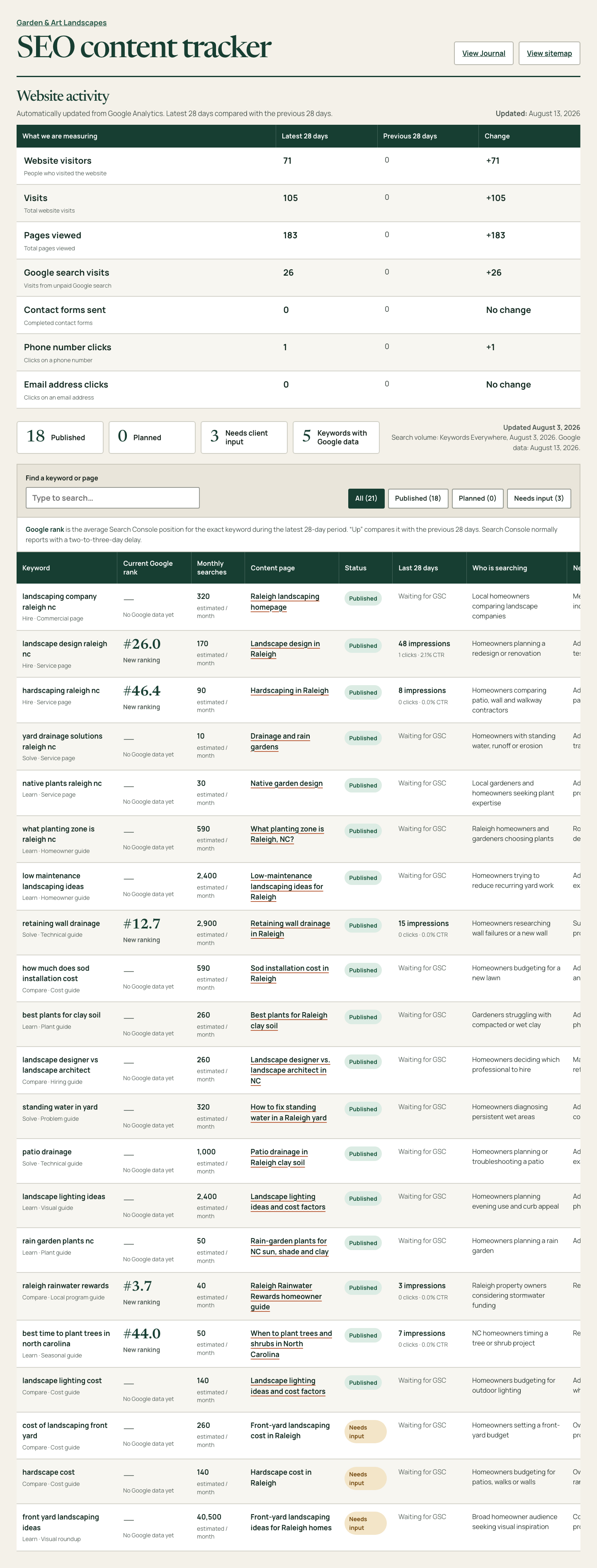
I built a public-facing SEO tracker so the work never disappears into a black box. It shows:
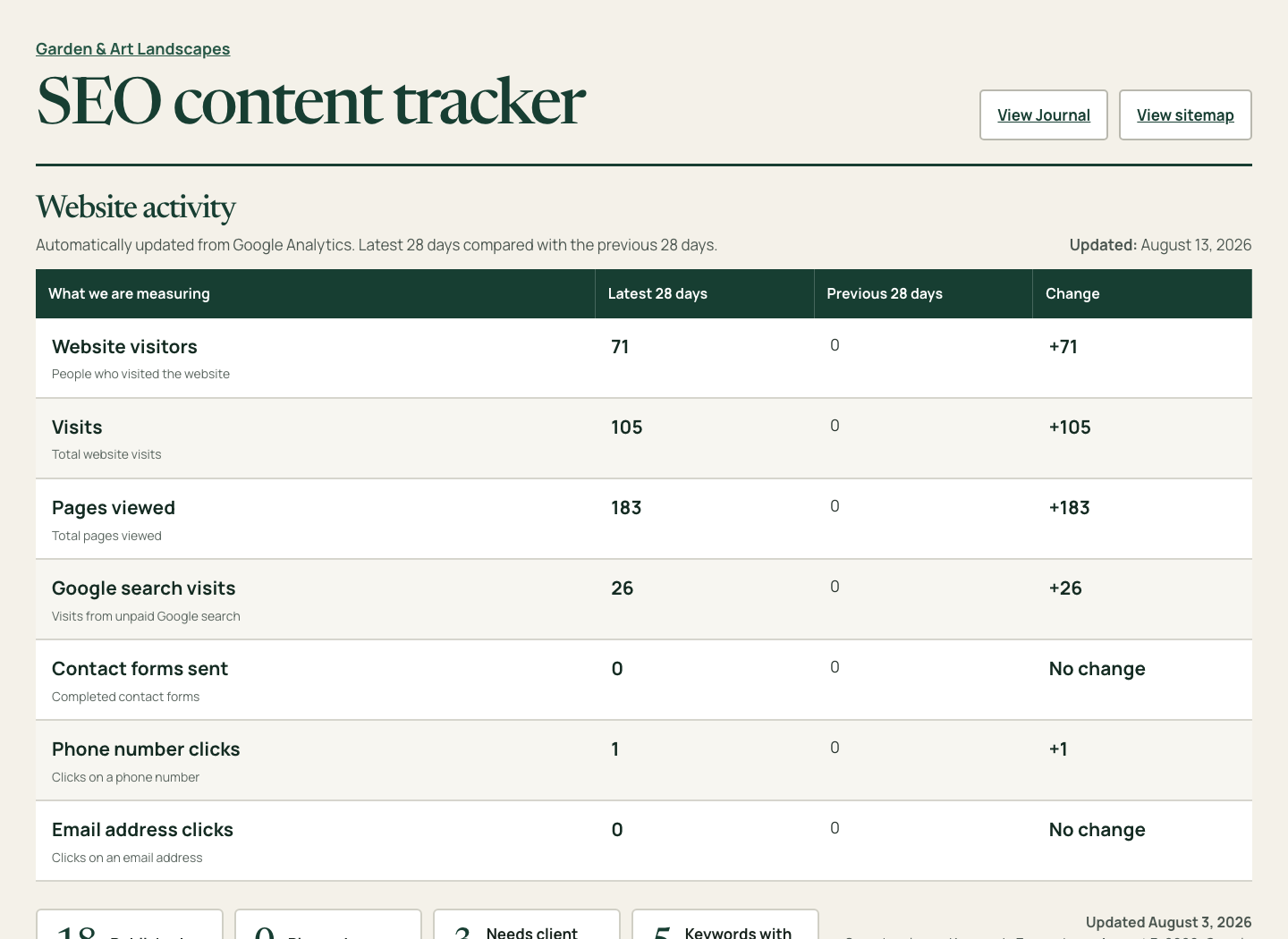
- Website visitors, page views, organic-search visits, and conversion actions
- Every target keyword and its estimated monthly search demand
- The live content page assigned to each keyword
- Planned, blocked, and published status
- Current Google position, impressions, clicks, and CTR
- Who is searching and what they are trying to accomplish
- The recommended next improvement for each page
- Data freshness notes for analytics, search volume, and Search Console
The dashboard updates automatically and links directly to the content journal, sitemap, and published pages.
Early results
The first publishing cycle put 18 useful pages live. In the dashboard snapshot captured on August 13, 2026, five exact target keywords had begun reporting Google data. Early positions included approximately 3.7 for a Raleigh stormwater-program guide, 12.7 for retaining-wall drainage, and 26.0 for Raleigh landscape design.
Those are early signals, not guaranteed outcomes. Some newer pages were still waiting for Search Console data, while others had already created clear improvement opportunities. The important result is that the company can now see what is ranking, what needs stronger proof, and what the system should work on next.
What “autopilot” means here
Autopilot does not mean publishing unverified claims with no supervision. It means the owner no longer has to perform every repetitive step by hand.
The business sets the strategy, facts, boundaries, and approval rules. The system continuously handles keyword discovery, prioritization, drafting, scheduling, deployment, measurement, and reporting. When a page needs information only the owner can provide, it stops visibly in a client-input queue.
That balance makes the workflow both faster and safer: automation keeps the SEO program moving, while human expertise remains the source of truth.
The outcome
Landscaping Raleigh now has an SEO operation that behaves like a system instead of a recurring project.
New opportunities enter a prioritized pipeline. Drafts are created from approved business context. Completed pages publish on schedule. Rankings and traffic flow back into the same dashboard. The next action is always visible.
The result is practical SEO on autopilot: less manual coordination, more consistent publishing, and a clear feedback loop between what homeowners search for and what the business creates next.
My role
SEO strategy, keyword research workflow, content-system architecture, prompt and guardrail design, automated drafting, editorial workflow, publishing automation, Search Console and analytics integration, rank tracking, dashboard design, and ongoing optimization.